




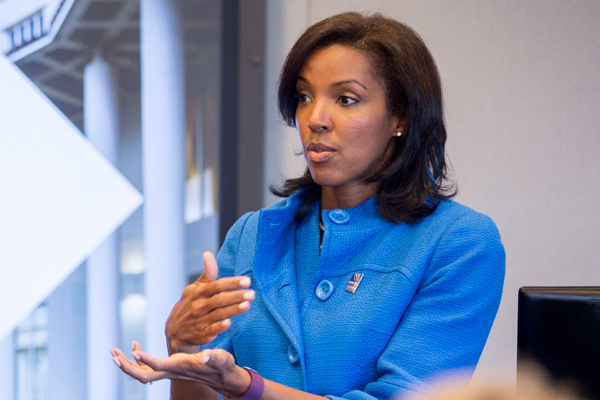
Erika James has a knack for making history. Five years after she was named the first African-American woman to be named dean of Emory University’s Goizueta Business School, James was named as the new dean at the University of Pennsylvania’s the Wharton School of Business.
She’ll be the first woman and person of color to head the top business school in its 139-year history.
“Erika is an award-winning scholar and teacher and a strong, proven leader who serves as dean of the Goizueta Business School at Emory University,” University of Pennsylvania President Amy Gutmann said in a news release.
“A passionate and visible champion of the power of business and business education to positively transform communities locally, nationally, and globally, she is exceptionally well prepared to lead Wharton into the next exciting chapter of its storied history,” she said.
James was credited with growing Emory’s school faculty by 25% by the end of her first year, where she built an innovation and entrepreneurship lab that opened to all students. By last year the school had one of the most gender-diverse faculty populations in higher education, it said.
“This is an exciting time to be in business education,” James said in the release. “The scope and platform of the Wharton School provides an opportunity to create far reaching impact for students, scholars, and the business community.”
James served as the senior associate dean for executive education at the University of Virginia Darden School of Business prior to becoming the dean at Emory.
She has a Ph.D. and master’s degree in organizational psychology from the University of Michigan, in Detroit and received a bachelor’s degree in psychology from Pomona College of the Claremont Colleges, in California.
Continue on to CNN Business to read the complete article.


Ava DuVernay’s When They See Us educated many people on the story of the Exonerated Five, the young men wrongly convicted in the attack on a Central Park jogger in 1989.
Now, the award-winning director and writer is using the groundbreaking miniseries for a new online education initiative.
Via ARRAY, her multi platform media company and arts collective, DuVernay is launching ARRAY 101.
On May 28, the Oscar nominee revealed on Instagram, “Today, I’m so, so proud to launch a project that my comrades at @ARRAYNow and I have been working on for over a year. Today, we launch #ARRAY101: dynamic learning companions for all our film/TV projects.
Continue on to BET to read the complete article…
Photo Credit: Getty Images


By Sara Salam
Madeline Delp knows no bounds. She applies her strengths, or her “superpowers” as she calls them, to focusing on what she can do—defying and transcending boundaries along the way
Consistent with her trailblazing efforts, Delp serves as the executive director of Live Boundless, an organization that educates people on those with disabilities and provides equipment like wheelchairs to those in need worldwide. Whether it’s coaching people on how to release the mental bounds of fear, showing others how to navigate the physical bounds that come with a disability or providing critical medical resources for people, Delp says her goal is to equip others with the tools they need to thrive.
“We aspire to challenge others to reach for a higher potential in their lives, and in turn, give back to the world around them,” she said.
Delp strives to follow her own credo. She competed in her first beauty pageant in 2016, the Miss Wheelchair North Carolina competition, and won. That same year, she would go on to win Miss Wheelchair USA 2017.
Delp is also the first person to compete in the Miss North Carolina USA pageant in a wheelchair. She placed in the top 10, won Miss Congeniality, and is the first woman in a wheelchair to make it this far in a state pageant in the history of the program.
She also became the first paraplegic girl to BASE jump. She has also rock climbed and gone skydiving. “Focus on your ability and what you can do,” Delph said. “Learn to accept fear as a tool, because when you’re able to look your fears in the face and do that thing that you’re terrified of, you’ll become a stronger person.”
When she was just 10 years old, Delp learned she would never walk again. In surviving a debilitating car crash, she suffered a severe spinal injury resulting in paralysis and incontinence.
Within a short time following this life event, Delp began a homeschooling program, because her high school campus was not wheelchair-accessible and unable to accommodate her. She didn’t see her father for almost a year following her accident. Her best friend was killed in a car accident the next year.
“People and circumstances I had thought would always stay constant were quickly fading away….and as the last domino in a long line of heartbreaks fell, a thick cloud of darkness surrounded me–so much so that I could barely breathe,” Delp wrote in a blog post for Aeroflow Urology.
In the wake of these tragic and angst-laden experiences, Delp struggled with anxiety and depression. She would spend as many as three hours a day waiting on toilets during her tween and teenage years as a result of her bladder challenges.
Delp and her mom moved to Detroit when she was 14 where she started going to a rehabilitation center. She had an accident in front of her physical therapy team while balancing with the aid of a harness on a treadmill.
“As we left, one of the therapists caught up with me and said, ‘Madeline, don’t be embarrassed. This kind of thing happens all the time! We think nothing of it–we are used to it. This is just your new kind of normal. It’s just pee.’”
Triggered by a realization of a new kind of normal, Delp decided to make a change.
“In my late teens I firmly decided that I didn’t want to be that person anymore,” Delp told Glamour Magazine. “I may not be able to walk, but I wanted to find something inside myself that was stronger than all the reasons I had to be negative. So I started trying to push myself in new ways.”
She describes a study abroad trip to Germany during college as a “second life catalyst event.” While not without accidents and incidents, Delp would travel to Germany three more times. She would also walk across the stage to receive her diploma. She graduated from UNC Asheville in May 2017 with a degree in foreign language and a concentration in management.
“I did all these things to show people with disabilities that you don’t have to be stopped by the limitations that people put on you.”


A new study led by India Johnson, an assistant professor of psychology at Elon University in North Carolina, finds that a major factor to increase the retention rate of Black women in STEM fields is to have African-American role models who will serve as mentors.
According to the research, Black women earn only 2.9 percent of all STEM bachelor’s degrees in the United States. This is far below the rate of White women, despite the fact that White women and Black women are equally likely to express an interest in STEM fields at the beginning of their college careers.
Researchers showed prospective students photographs of laboratory scenes at a fictitious school of science and technology and profiles of faculty members. Black students showed a greater likelihood of considering the fictitious school if a Black professor was shown or profiled. This was particularly true for Black women.
Co-author Ava Pietri, an assistant professor of psychology at Indiana University-Purdue University Indianapolis stated that “women who feel like they belong are more likely to enter and stay in STEM, so lack of belonging may be one reason for women of color’s lack of representation.”
Researchers also surveyed Black women at a four-year predominantly White four-year college and at a historically Black college. The women at the HBCU reported that they had on average two or three Black women role models in STEM fields. At the predominantly White school Black women reported either zero or one Black role model.
The researchers also found that White faculty members who went out of their way to encourage Black women students also had a positive impact. The authors concluded that although increasing representation of women of color in STEM is the best way to improve belonging, building tools to help White men or White women become better allies for Black women in STEM will also produce positive results.
The full study, Exploring Identity-Safety Cues and Allyship Among Black Women Students in STEM Environments, was published on the website of the journal Psychology Women Quarterly.


For the first time ever, the majority of U.S. medical school students are women, marking another milestone in the gradual diversification of those studying to become America’s next generation of physicians, according to 2019 data released by the Association of American Medical Colleges (AAMC).
Women constitute 50.5 percent of today’s medical students, building on steady increases in recent years that saw women account for the majority of first-year students in 2017 and most of medical school applicants in 2018.
Women reached the cusp of the majority in total enrollment last year, when they constituted 49.5 percent of all medical students, up from 46.9 percent in 2015.
“The steady gains in the medical school enrollment of women are a very positive trend. We are delighted to see this progress,” said AAMC president and CEO David J. Skorton, MD.
At the same time, while medical school classes continued to include more racially and ethnically diverse students, those groups remain significantly underrepresented in the overall physician workforce when compared with the general population and the patients they serve.
Among 2019 applicants and matriculants:
“The modest increases in enrollment among underrepresented groups are encouraging, but not enough,” Skorton said. “We must do more to educate and train a more diverse physician workforce to care for a more diverse America.”
Also among the findings:
For the 2019-2020 Academic Year
6.3% increase in Hispanic, Latino, or Spanish Origin matriculants
3.2% increase in black, African-American matriculants
5.5% increase in American Indian or Alaska Native matriculants
Source: aamc.org


The L.A. teachers union has elected the first woman of color, Cecily Myart-Cruz, to lead the organization, part of a familiar and experienced team that will include outgoing union President Alex Caputo-Pearl, who was elected as a vice president.
“I’m proud of the way we have worked with members to create a union that is inclusive, that is a fighting union, that cares not only about educators, but about parents, the community and students,” said Myart-Cruz, 46, who as union president assumes a role of influence and power in the Los Angeles Unified School District, the second-largest in the nation.
Myart-Cruz received nearly 69% of the vote to represent some 31,000 Los Angeles teachers, school nurses, counselors and librarians. The next closest was Marisa Crabtree, with nearly 11% of the vote in the five-candidate field. Crabtree had proposed to turn the union more toward classroom and teaching issues, while deemphasizing politics.
But Myart-Cruz said she sees the fight for political influence as essential to improving teaching and classroom learning conditions.
A little over a year ago, United Teachers Los Angeles went on strike for six days, bringing a focus to overcrowded classrooms and staffing shortages. While Caputo-Pearl headed that effort, Myart-Cruz was a key advisor. Caputo-Pearl is barred by term limits from seeking a third three-year term.
“The work is not done. Our educators need the resources and our babies need the resources as well,” Myart-Cruz said.
“By almost any measure, Caputo Pearl has been a strong and effective leader,” said Charles Kerchner, professor emeritus of the Claremont Graduate University School of Educational Studies. “The plan to swap offices with Cecily Myart-Cruz would essentially keep the leadership regime in place. That creates stability in ideas and agenda.”
All the same, Myart-Cruz emphasized that she will be fully in charge when she takes office in July.
The momentum from last year’s strike carried over into the May election of Jackie Goldberg, a union-backed candidate, to the school board. But soon after, L.A. voters defeated Measure EE, a parcel tax that would have increased local resources for schools.
The union is currently engaged in a high-stakes, big-money battle with supporters of charter schools for three contested seats on the seven-member Board of Education. If even one union-endorsed candidate loses, the direction of the board could shift away from some union priorities. These include limiting the expansion and spread of nonunion, privately managed charter schools and pushing for higher pay and increased school staffing.
Myart-Cruz, a district parent and single mother who identifies as biracial, black and Latina, has 25 years of teaching experience in elementary and middle schools. She has long been part of the union’s activist wing and helped lead a campaign to remove principals whom the union felt treated teachers unfairly.
As a regional chair she also helped organize a yearlong boycott against some standardized testing to take on what the union described as the “overtesting” of students. Union leaders argued that students took too many standardized tests and wanted the number reduced because they take away from learning time.
The new president also has been active at the state and national level in teachers unions.
The election turnout was low, but that’s been a consistent recent pattern in union internal elections. Close to 5,300 union members cast ballots out of about 31,000 eligible voters.
Continue on to the LA Times to read the complete article.


Most people call her “Lash,” but LaShyra Nolen’s name is hardly the only unique thing about her. Last year, she became the first black woman ever elected as class president of Harvard Medical School (HMS).
Born in Compton, California, and educated in Los Angeles, Lash grew up with big dreams and equally daunting challenges. Despite not seeing black women leadership reflected in society in general, she found inspiration in the strength of the women around her. Lash’s mom had her when she was only 18 years old. But as a single mom, she got her masters, while working numerous jobs to support Lash’s dreams.
“Mom pursued life with grit and a desire to win. She would tell me: ‘I’ll see you at the top,'” Lash tells Teen Vogue. In third grade, Lash won first place in a school science fair for a project that studied the patterns of fish. After this, she told her grandma she wanted to become a brain surgeon-slash-astronaut.
“My grandma would tell me that whatever I wanted to do, we were gonna make it happen,” Lash recalls. “After telling her I wanted to become a surgeon, she would tell me to protect my hands.”
Today, Lash is a Fulbright Scholar, activist, and an emerging leader in medicine.
Lash spoke to Teen Vogue about this moment in Harvard’s history and the advice she has for black girls everywhere.
Teen Vogue: What does it mean to you to be the first black woman elected as class president of HMS?
Lash Nolen: For me it means opportunity — opportunity in the sense that it will allow me to create a pipeline for others who look like me to hold positions of leadership at Harvard Medical School. When applying to HMS, I didn’t see people who looked like me in student council or positions of leadership at that level. I think it is important to show that black people can also be the face of a university.
TV: How do you use student council leadership to make a sustainable impact?
LN: I try to use my resources and platform intentionally. For example, this year with our budget, we decided to create an annual community outreach event for youth at local elementary schools for Halloween. Right now we are working on a project that will highlight members of our community who are custodial staff, cafeteria workers, security guards — the people that make our community whole, with portraits that will be displayed in the main atrium at HMS. By doing things like this, we’re able to sustainably change the narrative of who belongs on the walls and on the grounds of Harvard Medical School. To me, that answer will always be our community.
TV: What advice would you give to young girls of color pursuing their wildest dreams?
LN: Go get it. Our society has a way of implicitly reminding young black girls what they cannot achieve and what they cannot be, while explicitly giving the green light to white men. For those same reasons I almost didn’t apply to HMS. It wasn’t until my mentors told me that I was capable of being a student at a place like this. And there are so many young girls out there who are excellent and deserve access to opportunity, but won’t take the leap because society tells them that it’s not for them. So no matter how crazy it might sound, no matter if someone in your family has done it or not, just go get it, because you miss 100% of the shots you don’t take.
TV: How have you personally dealt with moving through the largely white, male-dominated world of science and medicine?
LN: I know myself and I know my history. Over the past couple of years, I have been doing a lot of unlearning and investigative research on systemic racism and the hidden contributions of my people to our society. This has given me a great deal of strength. When I walk into a room, no matter where I am, I know the strength of my people and how much they are the reason why these spaces even exist.
TV: What does being a student from Compton at Harvard Medical School mean to you?
LN: My mom raised me as a single mother. My grandmother is the most kindhearted and giving human I know. The city of Compton is one of the most resilient in the world. Growing up and watching them struggle and work so hard to give me what I had in my life, I couldn’t help but do everything in my power to make them proud. I feel like Compton made me scrappy. I’m hungry for opportunity, I’m hungry for justice, I’m hungry to see my people win. So, when you put someone like me at a place like HMS, I’m going to do whatever it takes so make that vision a reality.
Continue on to Teen Vogue to read the complete article.


A Georgia Uber driver recently graduated from Georgia State thanks to a man who helped her pay an outstanding debt that prevented her in finishing her degree program.
According to ABC News , Latonya Young recently graduated from the Atlanta university after starting her college journey many years ago. At age 43, Young now has an associate’s degree in criminal justice.
Her return to college was made possible thanks to an Uber passenger. According to ABC News, Young had picked up Kevin Esch for a 20-minute ride. Young told Esch about her desire to go back to college, but that a $700 outstanding debt prevented her from enrolling.
Shortly after the ride, Esch decided to help the mother of three out. Nearly 18 months later, Esch was there to see Young graduate.
“I have thanked him so much but I feel like I haven’t thanked him enough,” Young told “Good Morning America.” “It was not just the money but his willingness and his sacrifice for me to do better in life.”
“It was something I could do that I thought was worth it and would really help her,” Esch told “GMA.”
Continue on to KXLF to read the complete article.


By Susan Gonzalez/Yale News
“Community” is the word graduating senior Alanna Pyke utters most often when reflecting on her time at Yale College.
“What I really came to value here is a sense of community and being a part of something that is bigger than myself,” says Pyke of her Yale experience.
For Pyke, one of the most valuable communities was the one she found at the Native American Cultural Center (NACC), the place that inspired her to choose Yale out of the more than 15 colleges that accepted her, and where she experienced a deep sense of belonging. She was impressed by the fact that an entire building was dedicated for the NACC.
“The Native community and also Dean [Kelly] Fayard [assistant dean of Yale College and director of the NACC] were such a huge part of my Yale experience,” says Pyke. “The NACC at 26 High St. is a welcoming place, where you can go to relax or study or see friends. I spent a lot of time there.”
Pyke — the first Native student to be valedictorian of Massena Central High School in New York — says that no one in recent memory from her high school or her reservation had gone to Yale. Feeling supported on campus, while maintaining a connection to her indigenous roots, was important to her.
A member of the Akwesasne Mohawk Nation, Pyke grew up in upstate New York on the Akwesasne Reservation, which straddles the New York and Canadian border along the St. Lawrence River. Prior to seventh grade, she went to an elementary school on the reservation where she was taught the Mohawk language.
At her next school, which was predominantly white, Mohawk was not taught; Pyke was told that she could study French or Spanish instead.
“I remember crying when I found that out,” the Yale senior recalls. “I didn’t know why I was crying at the time but I know I thought it was a big deal that I couldn’t continue learning Mohawk. I eventually realized why it was a big deal: At school, I was no longer connected to my culture.”
As a first-year student at Yale, Pyke had a job as a first-year liaison at the NACC, helping new students feel welcome at the center. She soon found herself spending time there after her shift, and was encouraged by other Native students to attend special events or meetings or to take on leadership roles.
While she says she was initially “a little too shy” to hold an official post, she quickly found herself a member of the NACC-affiliated Association for Native American Students at Yale (ANAAY), the American Indian Science & Engineering Society, Yale Sisters of All Nations, and the Yale Native American Arts Council.
Pyke, who is majoring in molecular, cellular, and development biology (MCDB), acknowledges that it was sometimes challenging to balance her studies, research commitments, and leadership duties in the Native community. She says she is grateful for having the opportunity to study Mohawk at Yale (via the Native American Language Program) and was active in a student campaign to lobby the Yale administration to offer for-credit courses in indigenous languages.
As a woman of color in STEM, the Yale senior says the mentors she had in the sciences were vital to her success, and she is particularly thankful for the Science, Technology and Research Scholars (STARS) Program, which supports women, minority, economically underprivileged, and other historically underrepresented students in the sciences, engineering, and mathematics.
In addition to mentoring, the program provides research opportunities, networking, courses and workshops, and career planning to undergraduates in STEM disciplines.
While participating in a STARS Summer Research Program, she took a science course co-taught by a group of faculty members including Marina Moreno, associate research scientist and instructor in MCDB, who became Pyke’s faculty adviser. Moreno is also one of the STARS coordinators.
“She helped me through this entire endeavor of getting an education,” says Pyke. “Without the STARS program, there’s a big chance I wouldn’t have stayed in STEM. I don’t think I would have made it without Dr. Moreno and STARS mentor Rob Fernandez.”
This summer, Pyke will begin Harvard University’s Research Scholar Initiative, a post-baccalaureate program to enhance scholars’ competitiveness for Ph.D. programs. She is interested in continuing genetics or genomics research in the future.
“Many Native communities have a distrust of science generally and of genetic science in particular,” says Pyke. “It’s been used wrongly in the past, or used without consent.”
Pyke hopes to give back to her own community through scholarship. “Representation is important because it will inspire future generations of Native scholarship and scientists, and add diverse perspectives to different fields,” she says.
Source: news.yale.edu

By Stacy Braukman
Cuba native Diley (Dyla) Hernandez was in high school when she became fascinated by psychology and decided she wanted to pursue it as a field of study. Her father, who was a musician, and the rest of her family had not attended college and didn’t know how to help her get into the University of Havana.
“I had to figure that out myself,” she said. And she did.
Today, Hernandez is a senior research scientist at the Center for Education Integrating Science, Mathematics, and Computing (CEISMC), where she serves as the program director for GoSTEM, which aims to strengthen the pipeline of Latino students into postsecondary education. She is also the director for Culturally Authentic Practice to Advance Computational Thinking in Youth (CAPACiTY), an NSF grant-funded program to develop the new curriculum for the Introduction to Digital Technology course taught in Georgia high schools.
“My work is a combination of research, curriculum development, and teacher professional development,” she explains. “I have the great luck to actually be able to implement programs and strategies to help students in K-12 deal with a lot of the social and psychological consequences that prevent them from pursuing careers in STEM.”
Hernandez says her work is most fulfilling “when we actually get to talk to the students who are in our programs and we see in action the work that we’ve been doing, or hear from the students about the impact of that work. You realize that what you’re doing matters to people; that it’s actually making a difference in their lives, even if it’s small.”
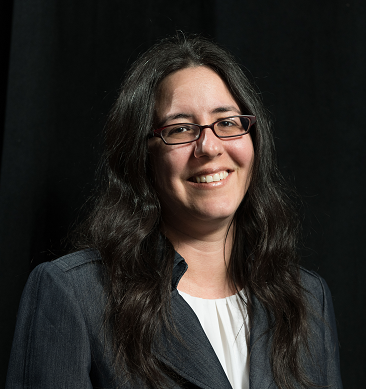
She describes one event that is especially important to her: the Annual Latino College and STEM Fair, which attracts between 500 and 1,000 Latino students and their families. Held at the Student Center, the event helps attendees envision a future at Georgia Tech—and feel like they belong.
“Sometimes, when they’re having conversations and they’re asking questions as part of this event, you feel like the stories of other Latino professionals, STEM leaders, and faculty really resonate with the students,” says Hernandez. “And you can see on their faces, ‘That is possible for me,’ or ‘I could do this.’ It’s like a little light that turns on. You can see the magic of something wonderful happening. Just to be able to be part of that is very rewarding.”
She sees a lot of potential at CEISMC and is committed to making an impact on the educational lives of Georgia students through innovative teaching methods, particularly in STEM fields. “It is an incredible opportunity to bring about real change,” said Hernandez.
Source: news.gatech.edu

MBA degrees cost a lot of money. Harvard’s MBA will set you back by $150,000 in tuition fees alone. But increasingly, it looks like the heavy investment is worth it.
In the United States, starting salaries for MBA graduates after business school have hit a record high this year, according to new data from the Graduate Management Admission Council’s Corporate Recruiters Survey 2019.
According to GMAC, the median annual base starting salary U.S. employers plan to offer new MBA hires is $115,000, more than double the median for new bachelor’s degree hires.
GMAC’s report is based on survey of 1,202 employers of graduate business school students in 45 countries worldwide and covers hiring patterns for graduates across programs—MBA and specialized masters—industries, and regions.
Here, we highlight how MBA salaries are changing around the world; we report on MBA and masters hiring trends; and we tell you which countries are most welcoming when it comes to hiring international students. Clue: it’s not the United States.
Average MBA starting salaries vary considerably by world region. The median annual base salary that European companies plan to offer new MBA hires this year is $95,000, and the median for Asia-Pacific companies is $45,000—less than half of what’s on offer in the United States.
Employers in the Asia-Pacific (63 percent) and the United States (56 percent) are more likely to plan to increase MBA starting salaries this year compared with European employers (49 percent).
Among U.S. employers, median MBA starting salaries are highest in the consulting ($135,000) and finance ($125,000) industries, consistent with global trends. Employers in the Northeast tend to offer the highest salaries, with lower salaries in the South.
Signing bonuses are offered by more than half of U.S. companies (58 percent with an average signing bonus of over $10,000) and about a third of companies Europe and the Asia-Pacific. Benefit packages vary by world region.
Although master’s degrees are becoming more popular, MBA graduates—usually at a later stage of their careers—can expect to earn more. While U.S. companies plan to offer a median annual base starting salary of $80,000 to Master in Management hires, European employers plan to offer only $35,000, which is equal to what they plan to offer bachelor’s hires.
Business schools with the highest MBA salaries in the USA include Stanford GSB, Harvard Business School, and Wharton—dominated the top tiers.
Source: businessbecause.com

